HEART Score Calculator
Score each component 0–2 · Total 0–10 · For chest pain presentations
Clinical interpretation
Score components
What is the HEART score?
The HEART score is a clinical decision tool for emergency doctors. It answers one question: does this chest pain patient need to be admitted, or can they go home safely?
Five variables — History, ECG, Age, Risk factors, Troponin. Each scores 0, 1, or 2. Total out of 10. Takes 90 seconds.
Built for the ED
TIMI and GRACE assume you already know the patient has ACS. HEART works before the diagnosis — for undifferentiated chest pain.
3 clear tiers
0–3 = discharge. 4–6 = observe. 7–10 = call cardiology. The score maps directly to a clinical action.
~98% NPV at low risk
In the Six et al. 2010 validation, a score of 0–3 had a 1.7% MACE rate. That's a number you can discharge on.
HEART score range and interpretation
The HEART score range is 0 to 10. Every point comes from one of the five components, each scored 0, 1, or 2.
The three risk tiers map directly to clinical actions:
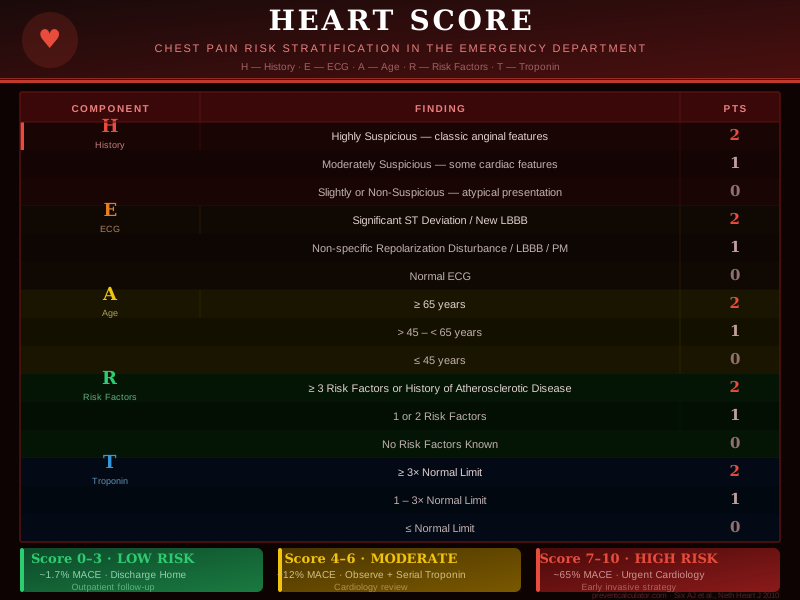
- HEART score 0–3 (Low risk): ~1.7% MACE at 6 weeks. Safe for discharge with outpatient follow-up, provided serial troponins are negative.
- HEART score 4–6 (Moderate risk): ~12–17% MACE. Admit for observation, serial ECGs, repeat troponin at 3 and 6 hours. Non-invasive stress testing or CCTA appropriate.
- HEART score 7–10 (High risk): ~50–65% MACE. Urgent cardiology consultation. Most proceed to early invasive strategy.
What does a HEART score of 3, 4, or 5 mean?
HEART score 3 sits at the upper boundary of low risk. The 6-week MACE rate is still roughly 1.7%, and most guidelines support discharge — but this is where clinical judgment matters. A patient with a score of 3 and a very suspicious history might warrant a longer observation period regardless of the number.
HEART score 4 crosses into moderate risk. At this level the MACE rate jumps to the 12–17% range. Admission for serial troponins is the standard recommendation.
HEART score 5 is solidly moderate. Same management pathway as a 4 — observation, serial troponins, cardiology review if troponin rises or symptoms worsen.
HEART score 2 is clearly low risk. Less than 1% MACE probability in most validation cohorts. Early discharge is appropriate with confirmed negative serial troponins.
HEART score chart — scoring criteria at a glance
Each component in the HEART score chart is scored on the same 0–1–2 scale:
- History: 0 = atypical/non-cardiac, 1 = mixed features, 2 = classic angina (crushing, pressure, radiates to jaw/arm, exertional, nitrate-responsive)
- ECG: 0 = normal, 1 = non-specific changes (LVH, early repolarization, pacemaker), 2 = significant ST deviation or new LBBB
- Age: 0 = under 45, 1 = 45–64, 2 = 65 or older
- Risk factors: 0 = none, 1 = 1–2 risk factors, 2 = known CAD or 3+ risk factors (diabetes, hypertension, high cholesterol, obesity, smoking, family history)
- Troponin: 0 = normal, 1 = 1–3× upper limit of normal, 2 = more than 3× ULN
HEART score vs TIMI score — which should you use?
This is one of the most common questions in emergency cardiology, and the answer comes down to one thing: what do you already know about the patient?
TIMI (Thrombolysis in Myocardial Infarction) was developed in 2000 for patients already diagnosed with unstable angina or NSTEMI. It assumes you have confirmed ACS. Its seven variables — age, CAD risk factors, prior stenosis, ST deviation, anginal events, aspirin use, and elevated cardiac markers — are designed to predict 14-day outcomes after the diagnosis is made, not to help you make the diagnosis in the first place.
GRACE (Global Registry of Acute Coronary Events) has a similar limitation. It predicts 6-month mortality after a confirmed ACS event. Useful for risk stratification post-diagnosis. Not useful when a 52-year-old walks into your ED with atypical chest pain and a normal ECG.
HEART was built specifically for that moment — undifferentiated chest pain, before you know anything. You don't need a confirmed diagnosis. You just need five data points you already have: the story the patient tells you, the ECG on the monitor, their age, their risk factor burden, and the first troponin result.
Head-to-head evidence
Mahler et al. (2015) compared HEART, TIMI, and GRACE directly in 1,070 patients across 8 US emergency departments. HEART outperformed TIMI on sensitivity for MACE and outperformed GRACE on specificity. More importantly, HEART correctly identified significantly more low-risk patients eligible for early discharge — the decision that actually reduces unnecessary admissions and costs.
A 2016 meta-analysis by Laureano-Phillips et al. covering over 11,000 patients confirmed HEART's superiority for ED chest pain triage compared to both TIMI and GRACE. The HEART score's area under the ROC curve was consistently higher across studies.
When TIMI is still useful
TIMI isn't useless — it's just being used in the wrong setting when applied to undifferentiated ED chest pain. If you're managing a patient post-catheterization or risk-stratifying a confirmed NSTEMI for timing of intervention, TIMI is appropriate. In that context, it was validated and it works. The mistake is applying it before the diagnosis exists.
Practical summary
Use HEART when the patient arrives. Use TIMI after you have a diagnosis. They answer different questions at different points in the clinical timeline.
The HEART Pathway — accelerated chest pain protocol
The HEART score tells you the risk tier. The HEART Pathway tells you what to do with it — specifically, how fast you can safely discharge low-risk patients using a structured, time-based protocol.
How the HEART Pathway works
The Pathway combines two things: a HEART score of 0–3 AND two negative high-sensitivity troponin measurements taken at 0 and 3 hours. Patients who meet both criteria are classified as very low risk and can be discharged from the ED without admission or further cardiac workup.
The logic is sound. A low HEART score means the clinical picture isn't suspicious. Negative serial troponins at 0 and 3 hours means there's no ongoing myocardial injury. Together, the negative predictive value for MACE at 30 days approaches 99%.
Evidence behind the Pathway
The HEART Pathway was prospectively validated by Mahler et al. in a 2015 randomized controlled trial — one of the few RCTs ever conducted on a clinical decision pathway in emergency medicine. Key findings:
- Objective early discharge rate increased from 39.9% to 51.7% in the HEART Pathway group
- No increase in 30-day adverse events — the safety endpoint was met
- Average cost reduction of approximately $1,200 per patient
- Hospitalizations reduced by roughly 20%
A subsequent meta-analysis covering over 10,000 patients confirmed these findings. The Pathway is now endorsed by the American College of Emergency Physicians (ACEP) as a preferred chest pain risk stratification strategy.
HEART Pathway with rapid troponin protocols
With the adoption of high-sensitivity troponin (hs-cTnI or hs-cTnT) assays, some centers have moved to a 0- and 1-hour protocol instead of 0 and 3 hours. When hs-troponin is available, a 1-hour delta troponin combined with a HEART score of 0–3 achieves similar safety outcomes with faster throughput. This is particularly relevant in high-volume EDs where bed availability is the limiting factor.
Who the Pathway doesn't apply to
The HEART Pathway has clear exclusion criteria that are often overlooked:
- New ST elevation on ECG — this is a STEMI until proven otherwise, bypass the Pathway entirely
- Hemodynamic instability — not appropriate for risk stratification tools
- Known history of ACS within the last 6 weeks — prior event confounds troponin interpretation
- Renal failure — troponin clearance is impaired, baseline elevation is common
- Non-cardiac chest pain clearly established by another diagnosis (pneumothorax, aortic dissection, PE)
HEART score 3 — the boundary case in the Pathway
A score of exactly 3 is where clinical judgment matters most. The Pathway technically classifies this as low risk eligible for discharge — but a patient with a score of 3 driven by a highly suspicious history (2 points) rather than age or risk factors deserves a longer look. The number is a guide, not a mandate. The Pathway works best when the clinician uses it as a framework, not a replacement for pattern recognition.
Marburg Heart Score — how it differs
The Marburg Heart Score is a separate tool designed for primary care settings, not the ED. It helps GPs decide which patients with chest pain need urgent referral to cardiology. The variables overlap partly with HEART (age, sex, known CAD, patient impression, recent exercise pain) but it's scored differently and validated in outpatient populations.
If you're a GP assessing chest pain in clinic, the Marburg Heart Score is more appropriate. If you're in an ED with ECG and troponin results, use HEART.
HEART score vs calcium heart score
These answer completely different questions and are often confused because of the name.
The HEART score is a clinical triage tool for acute chest pain in the ED — it uses history, ECG, age, risk factors, and troponin.
The calcium heart score (coronary artery calcium score, or CAC score) is a CT measurement of calcified plaque in the coronary arteries. It's used for long-term cardiovascular risk stratification in asymptomatic, stable outpatients — the same population the AHA PREVENT Calculator was built for.
A calcium score of zero is ideal. 1–99 is mild. 100–299 is moderate. 300+ is high risk and typically changes the treatment conversation.
Use HEART in the ED. Use the calcium score and PREVENT in the clinic.
Frequently asked questions
What does HEART stand for?
History, ECG, Age, Risk factors, Troponin.
What is a normal HEART score?
0–3 is low risk. There's no "normal" — any chest pain needs evaluation — but a score of 0–3 carries about 1.7% MACE risk at 6 weeks, which supports discharge.
What HEART score triggers admission?
4 and above. A score of 4–6 means observation with serial troponins. A score of 7–10 means call cardiology — 65% of those patients have a major cardiac event within 6 weeks.
How does the HEART score compare to MDCalc?
The calculator here uses identical HEART score criteria to the MDCalc version, based on the original Six et al. (2010) validation. The difference is the interface and the fact that this calculator also shows a live score preview as you fill in each field.
Can the HEART score rule out a heart attack?
Not definitively — but a score of 0–3 with two negative high-sensitivity troponins has a negative predictive value of approximately 98–99%. It's one of the strongest rule-out tools available for undifferentiated ED chest pain.
What is the HEART Pathway?
An accelerated protocol combining a low HEART score (0–3) with serial high-sensitivity troponin at 0 and 3 hours. Patients meeting both criteria can be discharged early. Studies show it reduces hospitalizations by 20% without increasing adverse events.
Is the HEART score validated?
Yes. The original Six et al. study (2010) prospectively validated 122 patients across 10 Dutch hospitals. Backus et al. (2010) validated it in 2,440 patients with 98% NPV at low risk. Mahler et al. (2015) confirmed it in 1,070 US patients across 8 sites. It's one of the most validated acute chest pain tools in emergency medicine.