Am I having a heart attack? How this female quiz works
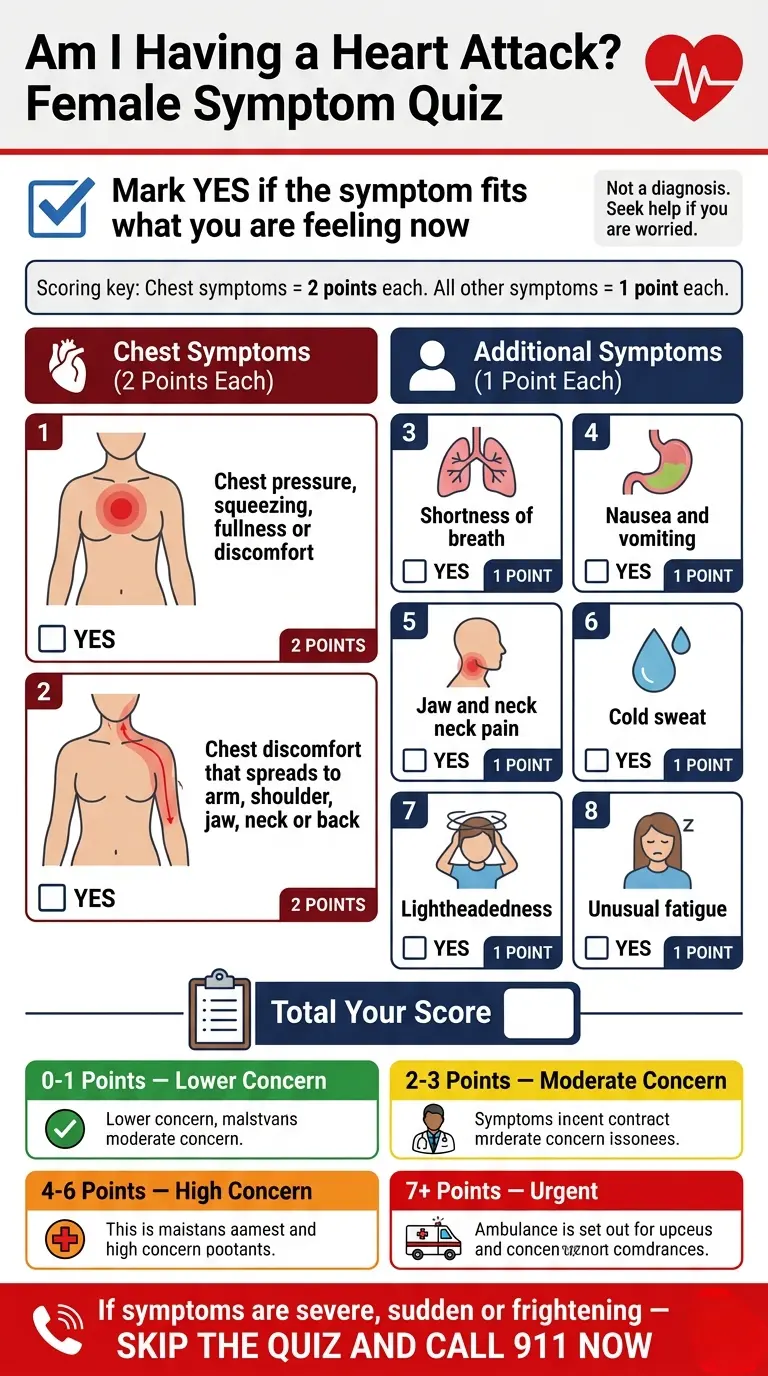
This am I having a heart attack female quiz uses 8 clinically-informed questions to screen for the atypical symptoms women most commonly experience — jaw pain, severe fatigue, nausea, and shortness of breath — not just the classic chest-clutching presentation that most symptom tools are built around.
Women's cardiovascular biology is genuinely different from men's, and it affects everything from how a heart attack develops to what it feels like. A 2012 study by Canto et al. in JAMA Internal Medicine found that 42% of women who experienced a myocardial infarction reported no chest pain at all. They had jaw pain, felt exhausted, or vomited. They often thought it was the flu.
Symptom differences at a glance
| Symptom | Women F | Men M |
|---|---|---|
| Chest pain | Less common; often described as pressure or tightness rather than crushing pain | Classic, prominent symptom — the textbook presentation |
| Jaw / neck pain | More common — can be the only symptom | Less typical |
| Fatigue | Very common — often severe and unexplained | Less prominent |
| Nausea / vomiting | More frequent — misread as stomach flu or indigestion | Occasional |
| Shortness of breath | Common, can occur without any chest symptoms | Common |
| Cold sweats | Common | Common |
| Prodromal symptoms (weeks before) | Much more common — unusual fatigue, sleep disruption, anxiety | Rarer |
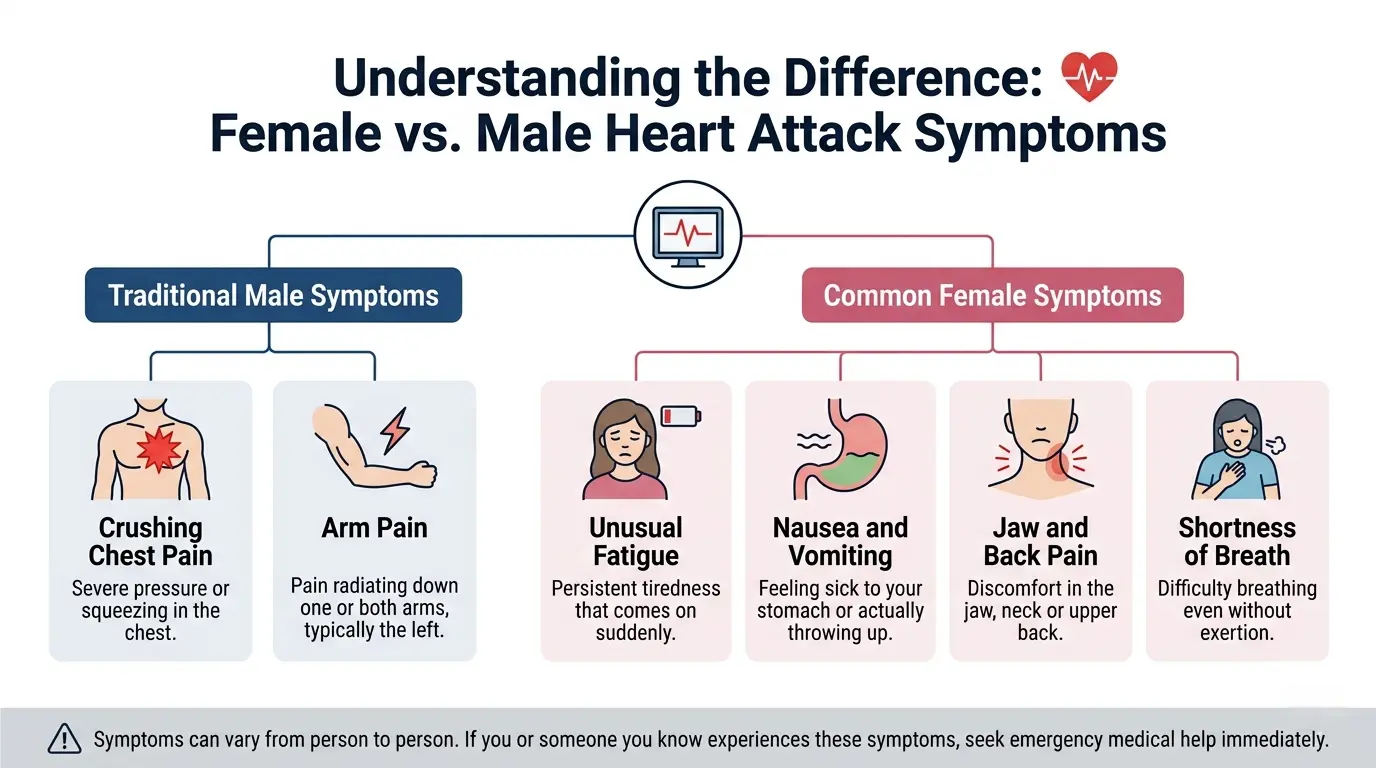
What are the 3 most important warning signs of a heart attack in females?
When women ask "how does a woman know if she is having a heart attack," three symptoms stand out above all others in the clinical literature — and two of them rarely appear in the movies.
- Unusual, crushing fatigue with no clear cause. Not the tiredness that comes from a bad night's sleep. The kind that stops you mid-sentence, mid-task, mid-movement. In the McSweeney et al. Circulation study, 70% of women reported this in the weeks before their heart attack — more than any other symptom.
- Shortness of breath, often without any chest discomfort. Getting winded climbing stairs that never bothered you before. Breathing feeling labored while sitting still. In women, this can be the only symptom of a heart attack in progress.
- Jaw, neck, or upper back pain. Women are significantly more likely than men to experience pain that radiates to the jaw or neck rather than the classic left-arm presentation. This is most often dismissed as a dental problem or muscle strain — and the one most likely to delay a woman calling for help.
6 signs of a heart attack 1 month before — what women report
One of the most important things women can know about heart attack symptoms: many heart attacks announce themselves weeks in advance. The question "how long can a woman have symptoms before a heart attack" has a medically documented answer — up to 4 weeks before the cardiac event itself.
- Unusual fatigue (70% of women). Not explained by activity level or stress. A heaviness that doesn't lift with rest — the most frequently reported prodromal symptom by far.
- Sleep disturbances (48%). Difficulty falling asleep, waking in the night repeatedly, or not feeling rested despite a full night's sleep.
- Shortness of breath (42%). Becoming winded with activities that were previously effortless — climbing stairs, walking to the car, carrying groceries.
- Indigestion or nausea (39%). A persistent low-level nausea or "stomach upset" feeling not tied to meals or a specific food.
- Anxiety (35%). A sense of unease without an obvious trigger. Some women describe it as dread or a feeling that something bad is about to happen.
- Heart palpitations. An awareness of the heart beating, fluttering, or beating irregularly — especially at rest.
These symptoms are individually easy to explain away. The pattern of multiple new symptoms appearing together — especially in a woman over 40 with any cardiovascular risk factors — warrants medical evaluation. Don't wait for chest pain.
How to rule out a heart attack at home — and when you can't
- Check the duration. Cardiac symptoms lasting more than 5 minutes and not resolving with rest are a medical emergency. If you've had symptoms for over an hour — call emergency services now.
- Check the combination. A single unusual symptom is less alarming than two or three occurring together. Shortness of breath + fatigue + jaw discomfort simultaneously: do not wait.
- Check your risk profile. If you have high blood pressure, diabetes, high cholesterol, a family history, or a previous cardiac event, your threshold for seeking emergency care should be lower.
- Use the quiz above. This female heart attack symptom quiz gives you a structured assessment weighted specifically for atypical symptom patterns unique to women.
What you should not do: take antacids or ibuprofen and "wait it out." Many women who were having heart attacks have done exactly this. If in doubt, call emergency services. Use the heart attack risk calculator after the acute episode to understand your 10-year coronary risk.
Heart attack vs panic attack in women — how to tell the difference
This is one of the most searched questions women have about cardiac symptoms — and for good reason. The physiological overlap between a cardiac event and a panic attack is real. Both can cause: shortness of breath, chest discomfort, heart racing, dizziness, and a feeling of dread. Women in cardiac studies frequently report that their heart attack felt, at first, like a panic attack.
| Feature | Heart attack ❤️ | Panic attack 🧠 |
|---|---|---|
| Onset | Gradual build, or sudden onset at rest | Usually sudden, often triggered by stress |
| Duration | Stays or worsens — doesn't fully resolve | Peaks at ~10 min, fades within 20–30 min |
| Chest pain | Pressure, tightness, heaviness; may radiate to jaw, arm, back | Sharp, localised; stays in the chest |
| Response to rest | Does not improve — often worse at rest | Often improves with slow breathing and calm |
| Cold sweat | Common without anxiety trigger | Sweating from intense fear/adrenaline |
| Jaw / neck pain | More common — can be the main symptom | Not typical |
| Nausea | Common, especially in women | Less common |
| After the episode | Exhaustion; symptoms may recur | Embarrassment; feel "shaky" but rapidly recover |
| Confirm / rule out | Only via ECG + troponin blood test | Clinical assessment after cardiac is excluded |
The critical point: you cannot tell the difference on symptoms alone — and neither can the ER without tests. If you genuinely cannot distinguish between the two, that uncertainty is itself a reason to seek medical evaluation. Do not drive yourself.
Average age of heart attack in females — and what changes by country
The average age of a first heart attack in women is approximately 70 years old in the United States — about 7 to 10 years later than in men. However, this headline figure conceals important nuance.
Heart attack symptoms in women over 50
Women over 50 are entering or past the post-menopausal risk window. Estrogen's protective effect on blood vessels declines sharply, and cardiovascular risk accelerates. Symptoms remain the same as for younger women but atypical presentation is more common in this group: unusual fatigue, jaw or neck pain, shortness of breath without chest pain, nausea, and cold sweats. Women over 50 with diabetes or hypertension are also more likely to experience silent heart attacks with minimal symptoms.
Heart attack symptoms in women over 60
By age 60, women's cardiovascular risk profile approaches that of men of the same age. Women in their 60s are more likely to have multiple risk factors simultaneously (hypertension, elevated cholesterol, and metabolic syndrome). Atypical presentation remains common but clinical studies show women over 65 are also more likely to experience the classic chest pressure presentation — though still less frequently than men. Silent heart attacks (no symptoms or very mild ones) are more prevalent in this age group due to diabetic neuropathy masking pain signals.
- Heart attacks in women under 50 are rising. A 2019 Circulation study found the proportion of heart attack hospitalisations in women aged 35–54 increased from 21% to 31% over two decades — driven by rising rates of diabetes, obesity, and hypertension in younger women.
- Premature menopause significantly lowers the risk age. Women who experience menopause before age 40 lose estrogen's protective effect early.
- Autoimmune conditions are independent risk factors. Lupus and rheumatoid arthritis can cause heart attacks in women in their 30s and 40s.
For women in the UK searching "am I having a heart attack female quiz UK": the symptoms described on this page are the same regardless of geography. If you have active symptoms, call 999. NHS guidance mirrors this page: don't wait for chest pain.
For women in Australia searching "am I having a heart attack female quiz Australia": if you have active symptoms, call 000. The Heart Foundation of Australia recognises the same atypical symptom patterns.
Silent heart attack symptoms in women
Silent heart attacks are more common in people with diabetes (where nerve damage can reduce pain sensation), older women, and women with a history of MINOCA. If you have any cardiovascular risk factors and a routine ECG shows evidence of a previous infarction you weren't aware of, this is a serious finding requiring specialist cardiology follow-up regardless of how well you currently feel.
What women say about heart attack symptoms — and what the research confirms
Many women searching this topic have read real accounts from other women online — on Reddit, health forums, and community groups — before finding clinical information. Those experiences are valid, and they map closely to what the research confirms.
- "I thought it was anxiety." The single most common thread. Women describe what was later confirmed as a cardiac event feeling like a panic attack — racing heart, shortness of breath, a sense of dread. The physiological overlap is real, which is why an ECG is the only way to distinguish them in the moment.
- "The ER sent me home." Women are more likely to be discharged with a non-cardiac diagnosis. MINOCA is frequently missed. If you were sent home and still feel unwell, advocate for a troponin test and a follow-up stress test.
- "I had jaw pain for three days before." Jaw and tooth pain that comes and goes, especially on the left side, appears repeatedly in women's first-person accounts. It is one of the most frequently dismissed prodromal signs.
- "I was exhausted for weeks and thought it was work stress." Entirely consistent with the McSweeney et al. research: overwhelming fatigue in the weeks before is the most common warning sign, and the one people least associate with cardiac events.
Female heart attack symptoms: full checklist by urgency level
- Chest pressure, squeezing, tightness, or fullness lasting more than a few minutes
- Sudden jaw, neck, or upper back pain alongside any other symptom
- Shortness of breath that came on suddenly, with or without chest symptoms
- Cold sweat with no obvious cause, combined with any symptom on this list
- Sudden lightheadedness, dizziness, or fainting
- Nausea or vomiting combined with any of the above
- Any of the above that resolved but lasted more than 5 minutes
- Jaw or arm pain that has been coming and going over the past few days
- Shortness of breath that has been worsening over days without explanation
- Severe fatigue + indigestion + sleep disturbances all occurring together
- Unusual fatigue present for weeks that doesn't improve with rest
- Mild recurring chest discomfort you've been dismissing
- Persistent low-grade nausea not explained by diet or illness
- A vague feeling that something is physically wrong you can't pinpoint
The month-before warning signs — the research in full
In the landmark study by McSweeney et al. published in Circulation (2003), 95% of women who had a heart attack reported new or different symptoms in the weeks before it happened. The most common were: unusual fatigue (70%), sleep disturbances (48%), shortness of breath (42%), indigestion or nausea (39%), and anxiety (35%). Almost none of these sound like a heart attack — which is precisely why they are missed so often. If you've had several of these in the past month — especially alongside risk factors like hypertension, diabetes, or a family history — take it seriously.
MINOCA: when the arteries look clear but it was still a heart attack
MINOCA (Myocardial Infarction with Non-Obstructive Coronary Arteries) is a heart attack where the coronary angiogram looks normal — so doctors sometimes send patients home without a proper diagnosis. Women experience MINOCA at roughly twice the rate of men.
The mechanisms behind MINOCA include coronary artery spasm, plaque erosion (different from rupture), and microvascular dysfunction where the tiny arteries feeding the heart muscle malfunction. None of these show up on a standard angiogram the way a classic blockage does. If you are a woman who had a cardiac event and felt dismissed or undertreated, MINOCA may be relevant to ask your cardiologist about specifically.
What to do if you think it might be happening now
Call emergency services. Don't drive yourself, even if symptoms seem mild. Heart attack symptoms in women can be subtle and still indicate the heart muscle is being damaged right now.
While waiting: if you have aspirin and you're not allergic, chew (don't just swallow) one standard 325mg tablet. Tell the dispatcher or ER team about all your symptoms, including the ones that don't sound cardiac. Jaw pain. Nausea. Fatigue. Say all of it.
After the acute episode, or if your quiz result was low-urgency, use the 10-year coronary heart disease risk calculator to understand your cardiovascular risk based on the 2023 AHA PREVENT equations. That's where the proactive work happens.
Frequently asked questions
Sources: McSweeney JC et al. Women's early warning symptoms of acute myocardial infarction. Circulation 2003;108:2619–2623. | Canto JG et al. Association of age and sex with myocardial infarction symptom presentation and in-hospital mortality. JAMA Intern Med 2012;172(20):1540–1547. | Mehta LS et al. Acute Myocardial Infarction in Women. Circulation 2016;133:916–947. | Arnett DK et al. 2019 ACC/AHA Guideline on Primary Prevention of CVD. Circulation 2019;140:e596–e646. | Khan SS et al. Novel Prediction Equations for Absolute Risk Assessment of Total Cardiovascular Disease. Circulation 2023;148:1982–2004. | Lindahl B et al. MINOCA. J Am Coll Cardiol 2021;78:2316–2328.
This page is for educational purposes only and does not constitute medical advice. If you believe you are currently experiencing a cardiac emergency, call your local emergency services immediately.